

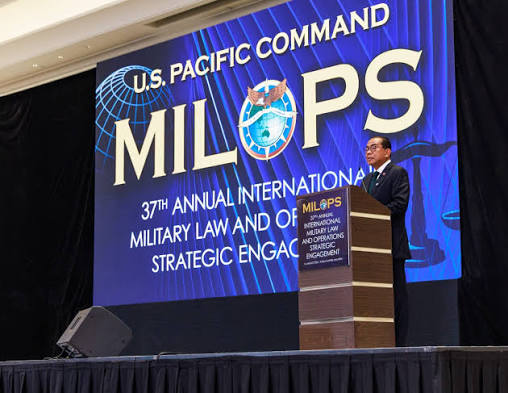
In an increasingly complex security environment, military strength alone is no longer enough to preserve peace and stability. Dialogue, trust, international law and strategic engagement have become equally important pillars of modern defence.
This was the central message advanced by Minister of Defence Malaysia Dato’ Seri Mohamed Khaled Nordin at the 37th International Military Law and Operations Conference (MILOPS) 2026 in Kuala Lumpur.
Through MILOPS 2026, the Defence Minister articulated Malaysia’s vision for an Indo-Pacific where dialogue takes precedence over confrontation, cooperation over competition, and international law over unilateral action.
Hosted by the United States Indo-Pacific Command (USINDOPACOM), in cooperation with Malaysia’s Ministry of Defence and the Malaysian Armed Forces (MAF), MILOPS 2026 brought together military commanders, legal experts, defence officials, policymakers and security practitioners from across the region.
For Khaled, the conference was more than an international defence gathering. It was an important platform to build confidence, strengthen professional trust and promote constructive engagement among nations at a time when geopolitical competition is intensifying across the Indo-Pacific.
ASEAN MUST REMAIN AT THE CENTRE
At the heart of Khaled’s message was a clear conviction: there can be no meaningful Indo-Pacific engagement without a peaceful, stable and united ASEAN.
Southeast Asia sits at the geographical centre of the Indo-Pacific and along some of the world’s most important trade and maritime routes. At the same time, the region is increasingly exposed to strategic competition among major powers.
Malaysia’s position is that ASEAN must not become a theatre for such rivalry.
Instead, the Defence Minister stressed that ASEAN Centrality and its established security architecture must remain the principal conduit through which meaningful Indo-Pacific engagement takes place.
This reflects Malaysia’s approach of maintaining constructive relations with all partners while preserving the region’s strategic autonomy and ensuring that ASEAN continues to determine its own course.
ZOPFAN: A VISION THAT REMAINS RELEVANT
The Defence Minister also placed renewed emphasis on one of Malaysia’s enduring contributions to regional diplomacy: the Zone of Peace, Freedom and Neutrality (ZOPFAN).
First proposed by Malaysia in 1971 under the leadership of the late Tun Abdul Razak Hussein, ZOPFAN envisioned Southeast Asia as a region free from external interference and great-power rivalry.
More than five decades later, the principle remains highly relevant.
Despite differences in political systems, cultures, religions and economic structures, ASEAN has succeeded in maintaining relative peace while achieving substantial economic growth and regional integration.
The lesson is clear. Southeast Asia’s strength has never depended on choosing sides.
It has depended on the ability of its nations to maintain neutrality, encourage dialogue and coexist peacefully despite their differences.
PROTECTING THE PRINCIPLES THAT HOLD ASEAN TOGETHER
Another important pillar of Malaysia’s position articulated by Khaled was the continued importance of the Treaty of Amity and Cooperation in Southeast Asia (TAC).
Its principles of mutual respect, peaceful settlement of disputes, non-interference and regional cooperation have helped provide the foundation for decades of peace, stability and prosperity in Southeast Asia.
The Defence Minister stressed that nations seeking meaningful engagement with ASEAN must understand and respect these principles.
As geopolitical competition intensifies, preserving these established norms becomes even more important in reducing misunderstanding, managing differences and maintaining trust between nations.
MILITARY DIPLOMACY AS A TOOL FOR PEACE
Central to Khaled’s defence outlook is the belief that armed forces have a role beyond preparing for conflict.
Military diplomacy, including professional exchanges, joint exercises, humanitarian cooperation and legal dialogue, can strengthen relationships, improve transparency and reduce the possibility of miscalculation.
MILOPS 2026 therefore demonstrated how defence engagement itself can become an instrument of conflict prevention.
Military strength remains essential to national defence. But that strength should ultimately serve as a deterrent against conflict rather than an instrument for provoking it.
This is why the Defence Minister repeatedly underscored respect for international law and the rules-based international order throughout his address.
Wherever possible, differences between nations should be managed through dialogue, mediation and diplomacy rather than armed confrontation.
He also called on major powers to exercise their influence responsibly and consistently respect international law and established international norms.
MALAYSIA AS A BRIDGE FOR REGIONAL ENGAGEMENT
Malaysia’s participation in MILOPS 2026 also reflects Khaled’s push for the country to play a constructive role in shaping regional security conversations.
The gathering of senior military leaders, policymakers, legal experts and security practitioners from across the Indo-Pacific provided an important platform for difficult security questions to be discussed professionally and constructively.
Such engagement strengthens Malaysia’s role in regional security dialogue while creating opportunities for cooperation in military law, operational planning, humanitarian assistance, disaster response and multinational security operations.
More importantly, it gives Malaysia the space to articulate its own strategic perspectives directly to international defence stakeholders.
A CLEAR VISION FOR THE INDO-PACIFIC
MILOPS 2026 ultimately provided a platform for Khaled to set out a clear Malaysian proposition for regional security.
Malaysia does not believe lasting stability can be achieved through military capability alone.
It requires credible defence capabilities alongside trust, transparency, diplomacy, mutual respect and adherence to international law.
It requires an ASEAN that remains united and central to the regional architecture.
And it requires major and regional powers alike to recognise Southeast Asia not as a battleground for competing interests, but as a bridge connecting nations through dialogue, cooperation and shared prosperity.
As strategic competition across the Indo-Pacific intensifies, Khaled’s message is clear: Malaysia will continue to strengthen its defence capabilities, but it will also continue to champion diplomacy, ASEAN Centrality and international law as essential foundations for lasting regional peace.